Thursday, November 13, 2014

The Tale of the Scientific Revolution

Once upon a time, there was a man named David Hume. He was a Scottish philosopher during the Scientific Revolution. Hume believed that miracles did not occur unless “the testimony be of such a kind, that its falsehood would be more miraculous, than the fact, which it endeavours to establish…”. He was skeptical that a miracle could happen in reality. His skepticism stemmed from his involvement and history with the ideas of the Scientific Revolution. Hume challenged many religious ideas on the basis that if they could not be experienced or tested, they did not exist.

This line of thinking was established during the Scientific Revolution. The Revolution changed many aspects of intellectual life. Scientists found a new way to look at the universe and everything in it. The Scientific Revolution only occurred due to three causes.
1.  Medieval intellect: Although many believe that the Middle Ages were a time of darkness, they set up the basis for intellectual thought. Universities were set up teaching a variety of subjects including philosophy. Science would eventually emerge from the field of philosophy and apply rational thinking to the world. Without these universities, science would not have emerged. 
2. The Renaissance: Many ideas and concepts from the Renaissance facilitated the Scientific Revolution. Diverse events such as humanism and the return to Greek math coupled with trade and new instruments lead to the Revolution. For instance, scientists fixed both longitude and latitude and invented new instruments in order to complete Renaissance caused trade. Additionally, the Renaissance stimulated progress on the scientific method. Two scientists lead to this modern scientific method. Francis Bacon provided the inductive thought. He believed in looking at tiny pieces and experiments and applying them to larger theories. He also formalized empiricism, which is the idea that everything comes from ones senses. Renee Descartes, however, believed in deductive reasoning. He took the general idea of a theory and applied it to specifics that took place in life. The combination of both inductive reasoning and deductive reasoning developed the scientific method. 

3. Religion: Protestantism and Catholicisms played important roles in the development of science. Some historians believe that Protestantism caused the scientific revolution. Protestants believed that it was important to think as an individual and come up with ones own ideas. They weren't suppose to just believe tradition because it was tradition. This was an important idea in science as well. Although Protestant thought was helpful to science, Protestantism as a religion was not. During the beginning of the Revolution, Protestant leaders were the biggest oppressors of Copernicus and scientific progress. Protestants in countries without close religious authority would eventually become more encouraging of science. Catholicism had the reverse relationship with science. They started out as the least oppressive of the religions but eventually became one of the most.  

Wednesday, November 12, 2014

The Scientific Revolution

The Scientific Revolution. What is it? Is it important? Is it real? And most importantly why did it happened while the Renaissance did not? These questions will all be answered in this blog post. So buckle your seat belts and get ready for the ride.

Simply put, the Scientific Revolution marked the emergence of modern science. It marked the beginning of moving away from speculation and to experimenting to prove theories. People like Galileo  and Newton made significant advancements in the fields of astronomy, physics, and mathematics. However with advancements came confrontations.

The biggest opponent against the Scientific Revolution was the Church. Since Aristotle's inaccurate theories were recovered in the Middle Ages, they had been incorporated into religious beliefs. For instance, Aristotle believed Earth was the center of the universe. Surrounding the Earth were spheres each in a perfect position. Beyond the tenth sphere was Heaven. This model of the universe not only gave reasonable and believable explanations but it also gave both God and humans a specific place in the universe and put human beings at the center. When this belief was questioned by Copernicus and Galileo, the church opposed them. Galileo was even put on trial for stating the earth was not the center but rather the sun. Though Galileo was put on trial by Catholics, Protestants tended to be more opposed to the Scientific Revolution because they took the Bible more seriously. 


The Scientific Revolution was very important. As stated previously, scientists during this time began testing theories instead of just thinking about them. They came up with logical and actual proof and evidence for things occurring. Furthermore, the Scientific Revolution changed the way people looked at the world. The conflict between religion and science began more prominent. People wondered what was right: religion or science? How could both coexist? This problem would only continue into the future and to modern day where debates are still continuing. 

This leads us to the big conclusion: Why the Scientific Revolution happened and not the Renaissance. 

1.) The Renaissance took Greek and Roman ideas. The Scientific Revolution looked at old ideas and made their own.
                Look at Renaissance sculptures, architecture, and paintings. They are all pretty similar to                    Greek and Roman art. How can something exist, if it does not have its own ideas. The Scientific Revolution looked at old ideas and made their own. For instance, they looked at Aristotle's layout of the universe, realized it was wrong, came up with a new one, and proved it with evidence. 

2.) Though in both movements only a few people participated, the Scientific Revolution effected or would effect everyone.
                Unlike the Renaissance, where only few people participated and only few were effected, during the Scientific Revolution a few people participated but many were effected. Because the Scientific Revolution lead to the ongoing question of faith vs. science, it not only effected people then but continued to in the future.

3.) If the Renaissance did happen, why did they not discover the flaws in science?
                  People look at the Renaissance as being this time of enlightenment. But what did it really accomplish. They studied the classics but failed to improve upon them. Furthermore, individualism probably kept people in the mind set of Earth being the center of the universe (individualism--> people are awesome--> people are center of universe). So if people did not push new ideas, did it really occur? The Scientific Revolution, however, pushed for new ideas proving it occurred.

4.) No one fought against the Renaissance.
                Think about it. Was there anyone who actually did not support the Renaissance? Was there any one who purposely fought against its ideas? No. Even the church did not have a problem with it. How could this be? All through history, there has never been an event or a movement that everyone has agreed upon. So logically if no one fought against the Renaissance that must mean it did not happen. However, many people opposed the Scientific Revolution because it challenged the way of thinking, it brought forth new ideas, and effected people. The Scientific Revolution did most defiantly  occur. 


In conclusion the Renaissance did not happen and the Scientific Revolution did. And if you still disagree....

Monday, November 10, 2014

Disappearing Children and The Big Three

As evidenced in The Vanishing Children of Paris, the same situation can be handled and viewed differently based on one’s perspectives (everything is relative). Due to economic distress, many vagrants from all over France came trickling into Paris. This created a sense of insecurity and anxiety in Paris. 


Order needed to be restored. The police believed disorder had to be “the work of malign forces infiltrating the social body in Paris.” Since it was rising amount of vagrants causing distress, the police came to the obvious logical conclusion of physically taking out people. For example, they sent innocent children playing on the streets to prison to set an “example,” and sent vagrants to America. As Mr. Yarnall stated, the police were patenting with broad strokes. Rumor spread like wildfire and the actions of the police added to the anxiety of the people. 

 
This created a divide and distrust between those who were supposed to keep order and the people. As more people came into Paris, the anxiety reached a new temperature. While the police believed that the people were causing unrest, the people believed the police were causing distress. They believed order would be restored through violence, hence the rioting.

As Kat said, once the police’s actions began to affect and threaten the mass’ lives, they rose up in anger. “They were taking all sorts of people indiscriminately.” 

The answer to the question who is disturbing the peace is different depending on who you ask. So, who is right? Who is our protagonist? As the police believed, “disorder cannot exist without someone being guilty of causing it.” As Becky said, each side had a little truth to them. “The real protagonist of the events had the usual myopic vision of those closely involved in a battle or rebellion and saw very little beyond their immediate surroundings.” Each side was narrow minded and could not see the other side or the big picture. The police were set on capturing children and the people were set on hurting the police. 

How was King Louis XV handling the distress? Simply put, he didn’t. Much like in All Quite on the Western Front, the king treated the distress around him with a sense of aloofness. “At the end of this day of violence, the authorities seem at last to have realized the gravity of the situation. At Versailles the dic de Luynes, assiduous chronicler of the minutiae of court life, records the event- almost reluctantly- between the intrigues of the clergy and accounts of the King’s hunting: “There have also been several uprisings in Paris over the last few days…” Without an absolute decision, which one would think the absolutist ruler would provide, the chaos on the streets continued. One could not get a definite answer on the situation even when asking witnesses of riots. It seemed as if no one wanted to become involved in the situation. Paris was much like a person who contracted a disease, but was too afraid of the doctor to get it checked out or treated. 
We also learned about the Big Three powers of Europe: Prussia, Austria, and Russia. Prussia, at this time, is consuming all the Germanic states into it’s own state. Austria is at the border of western and eastern Europe in what is left of the Habsburg empire. And Russia is constantly changing and creating different versions of the same state. The Ottomans are important because of how they affect Austria’s development. The Habsburg, Austrians, are experiencing both internal and external pressures. Surprise, surprise the nobility are causing internal pressures by continuing to exert too much influence and acting like a feudal nobility. External pressures are coming from the empire. This was both a good and bad thing. It was good because the Ottomans could be used as a glue that would unite the different nationalities in the Habsburg empire against a common enemy. On the other hand it was bad because, well, the empire was under attack. 

As we can see from the disappearing children and the Habsburg vs. Ottoman empire situation, I am right:


Russ, Pruss, Austr -ia

Absolutism took a different form in Eastern Europe at this time. Absolute monarchy was built upon socio-economic foundations. After the Black Death, Europe sought to rebuild its economy and population which had been so ruthlessly destroyed. In Eastern Europe, harsh serfdom was imposed upon the peasantry, leading to their exploitation along with an influx of agriculture. The noble landlord class grew in political power as they held monopolies on both the peasantry, through serfdom, and the monarch, as weak kings had to grant political favors in order to win support of the nobility. Their privileges were assumed through "hereditary subjugation," meaning that generations of peasants were indebted and bound to generations of landlords by past family ties. Eventually, in times of war and necessity, strong, absolute kingships would emerge in Eastern Europe. These monarchs gained power by imposing and collecting taxes without consent, by maintaining permanent standing armies that policed the country and enforced laws upon the king's subjects, and by conducting foreign affairs and international relations by their own desires.  


There's a "big three" when it comes to Eastern European countries at this time: Austria, Prussia, and Russia. Of these three countries, Russia's monarchy was the most absolute. As absolute kings arose and the powers of landowning, aristocratic nobility were reduced, the peasantry was often further crushed by economic burdens and lack of political voice. Here's an introduction to these three countries:


Tuesday, November 4, 2014

What's the right government for England?

A government and it’s citizens are bound by a social contract. However, people had conflicting views on what this social contract entailed. Hobbes believed that the government should be a monarchy and that the people must give up some of their rights to the monarch. 


On the other hand, Locke believed the terms of the social contract entailed the protection of citizens’ life, liberty, and property. If the government denies it’s people this, the people have the right to rebel. He believed in a constitutional state. 

Hobbes monarchy can be seen in Charles II. Everything was going well with Charles until people saw he had Catholic tendencies, especially when he made his deal with Catholic, French King Louis XIV for money. The biggest problem however was that Charles II did not have an heir, only bastard children. Therefore, the people knew Charles’ brother, James, would be king and he was a devout Catholic. James II believed in religious freedom for all. The only problem with this problem was that it gave religious freedom to Catholics, who protestant England did not like. James II also had a son, therefore ensuring a Catholic dynasty, which once again the Protestants did not like. 


Charles and James ruled with a cabal, or a cabinet, whose leader is now considered the prime minister. 


After the Glorious Revolution, William and Mary from Scotland were placed on the throne. It was the only successful invasion of England since William the Conqueror. If the Protestant Reformation had not been a failure, then the Glorious Revolution would not have happened. Everyone would have been protestant and there would not be Catholic conflict within the country, which is why people feared James II’s Catholic dynasty. 


What was more revolutionary: the English Civil War or Glorious Revolution?
The Glorious Revolution was more revolutionary because the English Civil War changed England only temporarily when Oliver Cromwell was placed in power. On the other hand, the Glorious Revolution changed the way England was structured through the creation of the Bill of Rights. The Bill of Rights enumerated the role of Parliament and the power it had, the power the monarch, and the rights of the people. This social contract made England a constitutionalist state, making England what it is today.


Monday, November 3, 2014

Locke-d and Loaded for Civil War

John Locke believed that the natural state of man is of perfect freedom and equality within the bounds of the law of nature. The law of nature states that because we are equal, no one has the right to threaten a person's liberty, life, health, or possessions. However, EVERYONE has a right to punish any wrongdoers. Because of this equality among all peoples, the only way that a ruler can have any power is if he has the consent of the governed.


How this relates to the English Civil War:
Our good friend Chucky I was ruling as an absolutist king. And according to Locke, absolutist governments violate the law of nature because it violates people's individual liberties.
Charles had dissolved Parliament for years, until he needed them to grant him money to squash the Scottish revolt. Up until this point, he ruled without requiring any consent from Parliament or from his subjects. The law of nature was completely disregarded and this led to civil war. John Locke believed this was justified. He held that people had the right to revolt if their government was acting as a tyranny by violating the people's liberties.
Although the civil war had more political causes than religious, it was still partly instigated by religious issues. Under Charles, William Laud created a new prayer book and bishoprics. The Scots resented this and revolted, which caused good ole' Chucky to summon Parliament after YEARS of ignoring them….. SUCKS. This led to a disconnection between Parliament and Charles, which eventually led to arguments and conflict, causing people to choose sides, and eventually sending the country into war. When Charles lost, he was promptly beheaded and the kingship abolished.


However, Parliament was not of a one-track mind. Not all of them wanted to execute Charles. The Rump Parliament, wanted to negotiate with Charles instead of zooming right into war. This exemplifies the diversity of thought in Parliament at this time.

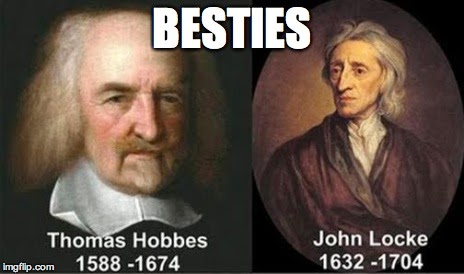
At first look, Locke and Hobbes look like they have totally opposite opinions on how a government should be run. Locke believes in equality for all peoples while Hobbes believes that equality among all men leads to war. However, they do agree on one thing- that a king can only rule with the consent of the governed. This means that "divine right" has nothing to do with it.


Would John Locke have liked Olly Cromwell?
After the civil war and Charles' execution, Cromwell, as the leader of the army that overtook the monarchy, became the "Protectorate". Although he fought on the side of Parliament in the civil war, after he came to power, he never called a single Parliament. He took advantage of his position and established a government similar to a military dictatorship. Locke would NOT have been a fan of this because Cromwell obviously was not respecting people's liberties by refusing to listen to anybody else's opinions but his own. The Irish for one hated him for crushing their rebellion, thereby crushing their hope of freedom and liberty.

In conclusion, John Locke didn't agree with Charles I's absolutist rule and he would't have agreed with Cromwell's military dictatorship. Locke would be a fan of constitutionalism, which requires the government to rule in line with the Constitution, thereby respecting the rights laid out for the people.

Sunday, November 2, 2014

Meanwhile in England...

While we were off studying French things, England was beginning to have some issues. In a matter of 100 years, England had 5 different rulers; James I, Charles I, Cromwell, Charles II, James II.  
 
It was a Cromwell sandwich.
After the death of Queen Elizabeth I, James I came into power. Although he was not a bad king, he would never be seen as good in comparison to Elizabeth. James will always be the Kesha to Elizabeth's Beyonce. 
 
James I started England on the path of absolutism. He whole heartedly believed in the divine right of kings, stating that a monarch has a divine right to his authority and is responsible to only God. Using his thinking, a king did not need to listen to anyone. This was a similar method as Louis was using in France. The only difference is that Louis believed in awing his subjects whereas James was not interested in displaying majesty and mystique of monarchy. James I had many issues with the House of Commons over his line of thinking because they did not want to bow down to the him. They were like wild animals that could not be tamed or domesticated. 
how the House of Commons felt
After James I, Charles I rose to power. Like James, he believed in absolutism. Charles, however, put it into practice. He took action against Parliament and dissolved it. Charles, then taxed the people without consent from anyone. This lead to  Parliament and the people believing he was a despot. Civil war began to rage in England over who should rule. The debate was only concluded with the beheading of Charles. This lead to Oliver Cromwell rising to power with the beginning of the interregnum.