Sunday, January 11, 2015

Radical Actions in a Moderate Era

The first stage of the French Revolution is described as a moderate era. However, this did not mean radical actions did not occur during this time. One example of this is the women's march on Versailles. Due to the many émigrés (nobles who were leaving France because of peasant uprisings) many working families had no market to sell to .Futhermore there was a rumor the king was fleeing. This caused around seven thousand women on October 5 to march from Paris to Versailles where the king was and demand bread. The women stormed the royal apartments forced the royal family to move to Paris in a carriage following the heads of two aristocrats stuck on pikes. 
"We want bread!!!"
The first stage of the Revolution was also marked by actions of the National Assembly. They changed the calendar and got rid of church holidays so France's connection to the church would be lessened. Furthermore, from the church property they confiscated, the National Assembly created assagnats, a new paper currency. They also established the metric system, wanted people to use "thou", abolished the feudal system, and created 83 departments in order to weaken feudal nobility. Under the National Assembly, the king could really only come up with ideas because law making was left up to the assembly. 

On topic the National Assembly covered was women's rights. They created laws that broadened women's rights such as the right to a divorce or inherit property but the assembly still believed women's primary job was to raise children. Therefore, women still could not vote or hold office.  This was also supported by the idea that women would corrupt the government. However, these discriminations against women did not stop all women from making significant contributions to the revolution. One of the major supporters of the revolution was an english women, Mary Wollstonecraft. Unlike Edmound Burke who believed the French were throwing the baby out with the bath water, Wollstonecraft argued that to guarantee rights, certain steps had to be taken. Furthermore, Wollstonecraft also tried to eliminate the the sexual inequality women faced and wrote A Vindication of the Rights of Woman.

The National Assembly and the Moderate Era ended when it disbanded and no current members were allowed to rejoin. This lead to an entirely new group of men joining what would be called the Legislative Assembly. These men were still upper-class like the previous ones but were younger and less cautious than their predecessors. Furthermore, most of them were Jacobins. Eventually, the Jacobins would divide between the Mountain and the Girondists. 

Though the Mountain and the Girondists had their differences both wanted to continue "the war against tyranny." The French invaded many countries and sought to abolish feudalism in each one. Other countries opinions on the French Revolution had at first supported it because that meant France would be weak. However, as France began to invade others, a fear that France might infect other countries began to spread. 

The Early Stages

The French Revolution is broken into four stages:


The first stage, the moderate phase of the National Assembly, consists of major events that set the tone for the Revolution. 

The Oath of the Tennis Court - The National Assembly, at this point composed of the third estate joined by some parish priests, was coincidentally locked out of its meeting spot. The Assembly moved to a large indoor tennis court and held their meeting where they pledged not to disband until they had composed a new constitution.


Storming of the Bastille - Poor harvest led to economic depression that crushed the poor and the oppressed (which, at this point, comprised a great amount of the nation's population). Essentially "the straw that broke the camel's back," this crisis pushed the ordinary people into full on revolt against their government. 

In response to rumors that King Louis XVI was planning to disassemble and eliminate the National Assembly, the commoners of Paris invaded the Bastille (a prison) to seize arms and gunpowder. The prison surrendered to the mob and the crowd killed the prison governor and the mayor of Paris, parading their freshly detached heads on spikes.

From this point forward, peasants began to rise up all over France. The revolts of the poor and oppressed were violent, disorganized, spontaneous, and chaotic. However, this insurrection proved effective, especially against the feudal system.

The Great Fear - Due to economic crisis and unemployment rates, and increased number of vagabonds roamed the streets of French towns. Rumors (hey - Vanishing Children) arose that the aristocracy had strategically sent these vagabonds to attack the peasantry and their land. This Fear of vagabonds stoked the fire of the revolution, leading to more violent peasant uprisings against the aristocracy and feudal system.

Decree Abolishing the Feudal System - The first essential triumph of the peasantry during the French Revolution. All the old exactions imposed on the peasants, including serfdom, hunting rights, and village monopolies, were made null and void, and the feudal system was abolished throughout France. This victory boosted morale and motivated further revolt.

 Declaration of the Rights of Man - Issued by the National Assembly on August 27, 1789, the Declaration states mankind's natural rights, and based on those rights, guidelines for proper government and execution of law. Largely influenced by the US Constitution and by Rousseau, the Declaration states that "men are born and remain free and equal in rights." The document further elaborates on these rights, stating that man is naturally entitled to liberty, property, security, and resistant to oppression. It further describes that law is an expression of the general will, and calls for a representative government for a sovereign people, however still calls for a king (which is supposed to benefit the public).

This Declaration sets the tone for the rest of the Revolution, stating the rights that the revolutionaries desire and the ideals for government in which they believe. The rights expressed here are used as a basis for the majority of action taken throughout the Revolution. The battle cry of the French Revolution becomes "Liberté, égalité, fraternité," meaning "liberty, equality, and brotherhood."


Tuesday, January 6, 2015

Indolent Fools


In his book, What is the Third Estate?, Emmanuel Joseph Sieyes offers a logic to explain who comprises the Third Estate. Within the novel, he uses the definition of the Third Estate to provide an argument for greater rights for the third estate.
Tree of the Estates

So, what is the Third Estate? It is everything, but not everyone. The nation is comprised of the Third Estate, who are the people working productively for the nation. The nation, therefore, does not include the indolent aka  the parasitic privileged people who are not doing anything for the nation, but are reaping all the privileges. This included unproductive nobles and clergy who had privileges, such as exemption from tax, but did not contribute to society. It exempted clergy, such as a lowly priest who offered charity, or the king, who ruled over the nation. (This is probably why the French kept the king during the revolution). As the National Assembly proves, people can cross over into the Third Estate. As Sieyes states, “What is the Third Estate? It is the whole.” Because of the idle people, those who are productive and contribute to society (those who are society) carry much of the burdens, which is logically stupid. Basically, the idle privileged people were free loaders and did not deserve what they have. All they wanted was power and they caused trouble in the nation. 


The indolent people not only fail to contribute to society, but they sparked the fire that started the flames of the French Revolution. Louis XIV was in debt because he borrowed so much money to support the French and Indian War (Seven Years War). Louis XIV wanted to raise the taxes to pay off the debt, but the Parlement in Paris (a court not a legislative body), which consists of nobles, revolted because they wanted to have a say over the taxes; they wanted power. They demanded the King to open the Estates General, an advisory board, or else they would not pay the taxes.

However, there was an issue with the Estates General. In order to pass a law, two out of three of the estates needed to vote for it. However, each estate had a say, so the Third Estate was consistently being out voted by the indolent fools. The Third Estate argued for a vote by head not by house or double the third estate’s vote (which would end up in a bunch of ties as Becky pointed out) since they made up 97% of the population or, according to Sieyes, the whole nation. 

When the Revolution began, it is unclear whether division among the population is between the third estate and the insolent fools or between those who are the top of their estate and those at the bottom of each estate. However, it is important to note that in both situations division is created between the haves and have nots. 
Just in case anyone wanted the link to the French Revolution song. http://www.history.com/topics/french-revolution

Monday, January 5, 2015

Did Rousseau cause the French Revolution?

Did Jacques Rousseau cause the French Revolution? To answer this question, we must first analyze the themes of the Revolution and compare them to the themes of Rousseau's writing in The Social Contract. The themes of the Revolution, otherwise known as the call to arms, are liberty, equality, and brotherhood. The people revolted for the sake of establishing these 3 principals in French society and government.

The first, and most obvious, is liberty. The call for liberty was a call for individual human rights, no matter a person's social standing. This was a very radical idea in French society, where people's rights were determined by their social standing. The most liberal revolutionists pushed for sovereignty, where the people alone have the authority to make laws limiting an individual's freedom of action. In this system, legislators would represent the people in all of their decision making.
This type of theoretical justification of liberal self government partly evolved from ideas presented in The Social Contract. Rousseau saw the system of an absolutist monarch ruling over a wide array of people as comparable to the relationship of a master to his slave. "The moment a master exists, there is no longer a Sovereign, and from that moment, the body politic has ceased to exist." The French people would be able to take these words and easily adapt them to their cause of revolting against the king in order to receive a greater say in government.


The people's next call was for equality, especially among social classes. The 3rd estate, which constituted about 97% of the French population, was made up of people of varying economic conditions who were all given the same legal status. No matter how much a middle class merchant made, he would always share the same status as a peasant. And while the 1st (clergy) and 2nd estates (nobles) enjoyed special privileges and limited taxation, the 3rd estate paid the overwhelming majority of the taxes to the state. The majority of the state's budget was spent on debt service from foreign wars, which had no way of benefitting the 3rd estate.
Rousseau relates to this concern when he writes, "It will be said that the despot assures his civil tranquility, granted. But what do they gain if the wars his ambition brings down upon them... press harder on them than their own dissension would have done?" In relation to the French Revolution, what does the 3rd estate have to gain from supporting a monarch who demands taxes for wars that only benefit the 1st and 2nd estates?


Lastly, the French Revolution placed an emphasis on brotherhood. With the estates constantly at each other's necks, they would never be able to band together against the king. To fix this problem, the Parliament of Paris declared that the Estates General must be called to approve all taxes. While this did start off much debate and did not settle all of the country's problems, it certainly was a start.
"Whenever sovereignty seems to be divided, there is an illusion: the rights which are being taken as being part of Sovereignty are really all subordinate." So in other words, Rousseau is saying that as ling as the people are divided, like they are in the three estates, they will never truly have their fair share of power. But by joining together in the Estates General, the people were able to become more equal in power to the king.


Even if Rousseau was not the definitive stimulus for the French Revolution, his writing definitely played a substantial role. The only part of the revolution Rousseau wouldn't have supported was the reestablishment of the monarch. Perhaps the people were so used to having a king that they couldn't imagine a new form or government, or maybe it was because they believed the king gave them sovereignty by carrying out what they really wanted. Either way, Rousseau would not have approved. Because while the majority of philosophes supported a constitutional monarchy, he did not. Way to be different, Rousseau, too bad no one agreed with you.

Saturday, January 3, 2015

Enlightened Ideas + The French = Revolutio

During revolutions, ideas play a very important role in what will take place. This was no different for the French Revolution. The Enlightenment played a huge role in the French Revolution taking place and the ideas that were being fought for. Three enlightened thinkers played important roles in the revolution. 
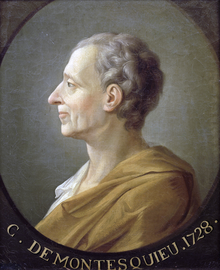
  1. The first phase of the French Revolution was led by Montesquieu. His thoughts on having a liberal constitutional monarchy with a divided sovereignty guided the revolution in its infant stage. The main difference between Montesquieu's thought and the revolutionaries was where the power would be divided. Montesquieu believed in the nobility and the monarchy sharing power yet the French revolutionaries thought that the non-nobility or the Third Estate should have a share in the power. 
  2.  After the king fled to Varennes, the people realized that a divided sovereignty was unobtainable. Their ideas shifted to Rousseau and Republicanism. The people were attracted to the new idea of Rousseau's freedom. In his ideas, freedom was ruling oneself. This would mean that the nation would rule itself. Rousseau became like a god to the people. His idea of freedom took over French thought and would never truly disappear.  
  3. The final phase of French thought during the Revolution was Voltaire. After Napoleon took over the government, French republicanism declined. Napoleon adopted Voltaire's idea of enlightened absolutism. The sovereignty of the state would be undivided and in the hands of the monarch. He also believed in suppressing the Church and institutions controlled by the nobility, since it would result in a strong central government. 
These three thinkers played a very important role in the Revolution. They were the guiding lights to what the people wanted to achieve. In my mind, Rousseau played the most important role in the Revolution. His idea of freedom was the dominant belief during this time. Without Rosseau's idea of Republicanism, the Revolution would have been less extreme. Rousseau offered the French a path to a new government. 

Thursday, December 11, 2014

The Effects on Family Life

As stated previously, the agricultural revolution had a major impact on the economics of society. However, the changes brought by the agricultural revolution also brought changes to the family life.

Before the putting-out system and the enclosure movement, people tended to marry older. The average marriage age was twenty-seven or older. The reason for this was before couples could marry, they had support themselves economically. Women had to earn money for a dowry and men had to wait for their fathers to die to inherit their money. Furthermore, officials made laws preventing marriage among peasants because it was believed freedom of marriage would lead to more abounded children and more money for welfare.

However, this changed after the agricultural revolution. Children began leaving home for jobs. They went to the cities for employment. For girls, this often meant working as servants. Not only was the work for a servant endless, but the servant girls were often abused. Their mistresses would call them names and beat them because that was one of the few way they could exert power in their lives. Also, servant girls were also sexually abused because their were no laws protecting them. If the girl became pregnant, she was thrown out on the steer in disgrace.
Often these girls thrown on the street were forced into prostitution. Sound familiar?  

This time period also resulted in an increase of illegitimate children. Previously, even when premarital sex did result in pregnancies, couples would get marry because they were tied to the land and in the small towns they were held accountable for their actions by the peasant community. In the city, there were no community controls.

The increase of illegitimate children was one factor in the growth of foundling homes but not the only. Often the babies abandoned at these homes were from married couples who could not feed another mouth. Over one third of all children abandoned were from married couples. However, these foundling homes were not so great for the babies left there. In the best homes, only 50% died. In the worst, up to 90% of children died. Dropping children off at foundling hospitals became an almost "legalized infanticide".
This women is "anonymously" dropping off her bread loaf  baby. I guess the artist just wants us to imagine the nun can't see her.

Due to the high infant mortality rate, many women gave birth to six or more children. However one in five and sometimes even one in three would die. This resulted in many historians believing at this time, parents had a lack of emotion for their children (though this is debatable). It was believed that since children would die so often, parents were not supposed to get attached. This theory of lack of emotion could be supported by the numerous cases of overlaying. This was when parents would suffocate their babies by "accidentally" laying on top of them in the night. Austira had to make a law stating it was illegal to have children under 5 in the same bed as the parents to prevent this.
Here is a picture of those attached crib beds we discussed in class. 
Another morbid way of killing babies this chapter discussed was with killing nurses. During this time it was a common practice for upper-class women to hire wet nurses for their children because it was believed nursing was a undignified practice. It was also a common belief that a nurse passed her traits to the baby. So when children turned out poorly, the nurse was said to have changed it. Killing nurses were nurses who would get paid to nurse a child and then let it die so they could nurse another and get paid again.

The agricultural revolution helped improve the economy but it also resulted it a worse family life. People were making more money after the revolution but things such as an increase in illegitimate and abandoned children and people leaving their families to work in the cities happened. One argument is that even with the less happy family life, people would be happier because they would have more money. On the other hand, it could be argued that even with less money, people would be more happy before the agricultural revolution because they would care more about having a better family life.

Tuesday, December 9, 2014

European History feat. 'Merica

The Colonies and European Economy

While the cottage industry was developing in Europe, the colonial economies also began to thrive economically. The agricultural industry boomed in British North American colonies, providing an expanding market for English manufactured goods. The colonies gave raw materials back to their mother country - the country could then export manufactured goods, selling them back to the colonies (or to other nations) and taxing the colonies' imports and exports. 

Atlantic trade:


The wealth derived from the colonies was based on a mercantilist system, largely introduced by the Navigation Acts. The Navigation Acts required the colonies to use British ships for all trade, and forced them to purchase manufactured goods exclusively from England, thus increasing British income. Soon other European nations followed England's lead and developed a system of exporting more than they imported, and engaging in foreign trade in order to increase wealth and power of the state. 


The colonies were overall crucial to Europe's, especially England's, economy. The colonies provided raw materials, a market for goods, and an outlet for surplus population. The Atlantic trade created a market of goods from the British North American colonies, such a tobacco and cotton, as well as sugar and rum from the Caribbean colonies, slaves from Africa, precious metals from South America, and manufactured goods exported from the mother countries. At this time, mercantilism and the colonies provided great benefits for Europe, especially England.

Ultimately, toward the end of the 18th century, the colonies began to grow autonomous, and their economies grew independently from England's. Leading to the Revolution and onward, British colonies become more of an economic competitor rather than provider. But for the majority of the seventeenth and eighteenth centuries, the colonies provided a significant benefit on British and European economy.

Then vs. Now

During the fifteenth century, European expansion and intercontinental economy was largely provided by the discovery of the New World and the spice islands. Dominated by Spain, exploration at this time led to a discovery of new lands and new routes, as well as new economies. Better access to the spice islands opened up a new market between Europe and the rest of Asia. Furthermore, as Spain made claims in the New World and began to exploit the natives, new markets emerged as a result of products including sugar, rum, and precious metals gold and silver. These new markets provided a boom in European economy, especially for the Spanish.

In the seventeenth century, as prior discussed, trade with the New World was largely dominated by Britain, and the Atlantic trade allowed European international economy to thrive. Raw materials from the colonies and manufactured goods from Europe allowed for the success of mercantilism.

The fine details of colonial relations in these two periods, of course, have their differences, namely in the dominating countries, the systems of trade, and the dominating products. In the fifteenth century, the Spanish exploited the natives and brought gold and silver back home; in the seventeenth century, the vast majority of the population of England's colonies were British immigrants, and their agricultural economy was largely dominated by British mercantilism.

 However, the goals and motivations are ultimately quite similar. Expansion during the fifteenth century as well as colonization and trade during the seventeenth century were majorly driven by European nations' interest in strengthening their economies and increasing their power. Goals of expansion along with those set forth by mercantilism were largely based on the desire for money and power, and with respect to that drive, the eras were similar in terms of intercontinental trade.